

The Vision Tax: Is High-Street Eyewear Overcharging You?

Content Manager
The "Vision Tax" Dilemma
Let's start with a fact nobody on the high street wants to say out loud: prescription glasses aren't a fashion splurge. They're a health essential, on the same list as insulin, inhalers, or a decent pair of walking boots. You didn't choose short-sightedness. You didn't choose astigmatism. And yet, every two years or so, you're handed a bill that behaves less like a healthcare cost and more like a toll booth.
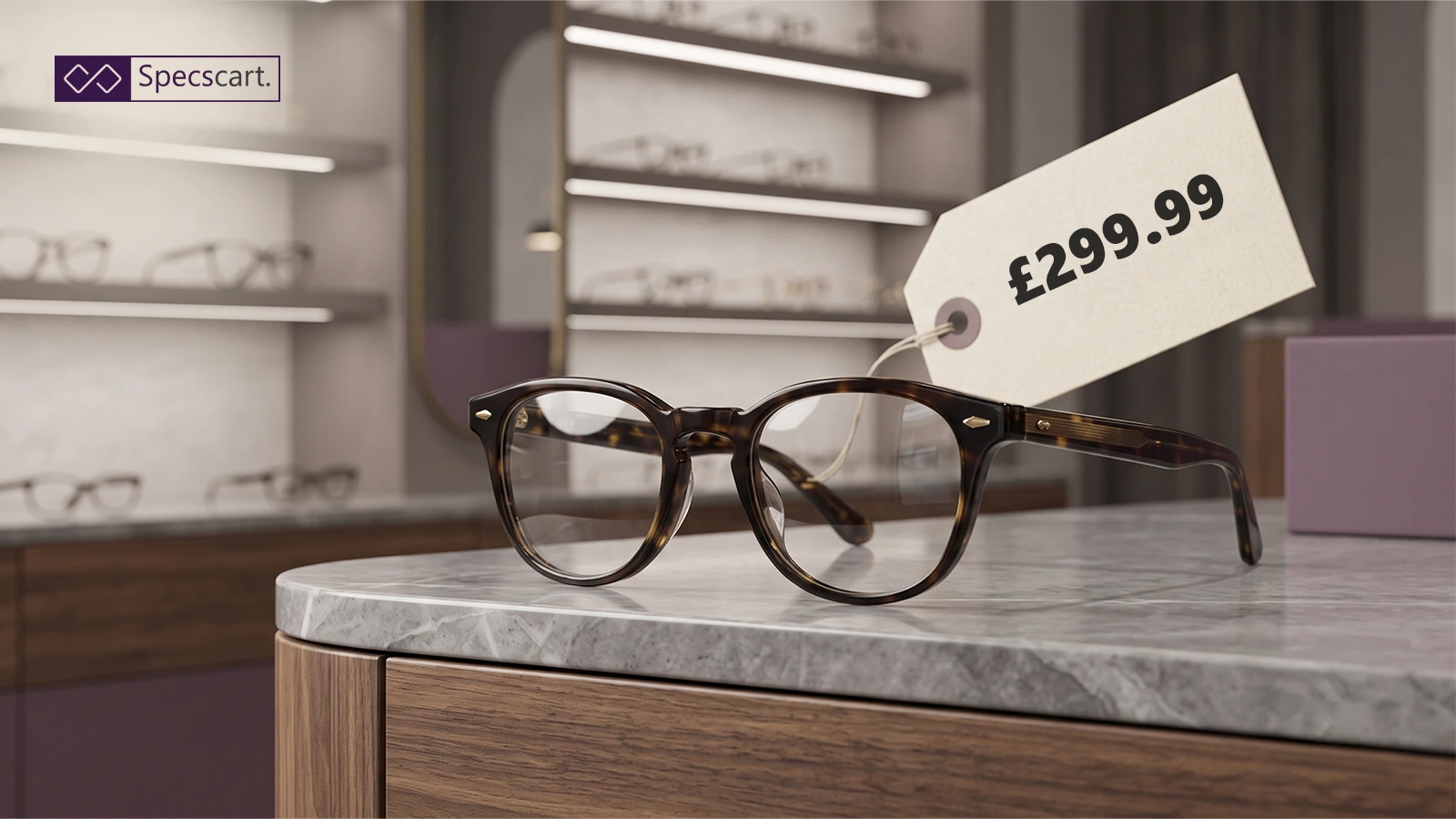
That's the Rigid Pricing Model at work. The industry-wide habit of bundling a £15 frame and a £10 lens into a £250+ "package," then charging you again for the bits that should have been included from the start. It's not one bad purchase. It's a recurring line item, quietly compounding over your entire adult life. The problem is that most of us have never sat down to actually add it up.
So let's do that.
Calculating The Lifetime Cost of Glasses
Assume you start wearing glasses at 20 and keep wearing them to 70. That means 50 adult years. Replace a pair every two years (a conservative estimate, since prescriptions change and frames wear out faster than that), and you're looking at roughly 25 pairs of glasses across a lifetime.
The High-Street Path
Average spend per pair, once coatings are added: £250–£400
Over 25 pairs: £6,250 to £10,000 across a lifetime
That's before factoring in "two-for-one" offers that quietly push you toward the pricier frame range to make the maths work in the retailer's favour
The Direct-to-Consumer Path
All-inclusive average cost per pair (frame, lenses, anti-glare, scratch resistance, UV protection): £50
Over 25 pairs: £1,250 across a lifetime
Put those two numbers side by side and the gap isn't a rounding error. It's £5,000 to £8,750 over a lifetime, for functionally the same prescription, in many cases from the same lens labs. That's a family holiday, a house deposit top-up, or a pension contribution, gone, not because your eyesight demanded it, but because the pricing model did.
The Hidden Health & Productivity Cascade

Rigid pricing doesn't just cost money, it changes behaviour, and not for the better.
36% of UK adults are currently wearing an outdated prescription, and 19% have resorted to self-repairing broken frames rather than replacing them, according to research from the Association of Optometrists' Voice of Optometry panel. 7 in 10 optometrists surveyed said they'd seen a patient in the previous three months who needed vision correction but took no action because they couldn't afford it.
Almost a third of glasses wearers admit to borrowing a friend's or family member's eyewear rather than spend money on their own, per the same AOP research.
Millions more simply delay booking an eye test altogether, not out of neglect, but out of what's best described as checkout anxiety: the quiet dread of knowing what's coming once the optometrist says "you'll need new glasses."
This creates what we'd call Single-Pair Vulnerability. One pair of glasses is being asked to do an impossible job: eight to ten hours of screen glare, the evening commute in the dark, harsh midday sun on the school run, and a five-a-side match at the weekend. No single pair is optimised for all of that, and the eyes bear the cost in the form of chronic visual fatigue, headaches, and squinting that becomes so routine it stops registering as a problem.
The knock-on effect shows up at work, too. A 2025 national survey of over 2,000 UK office workers by eyecare company Ocushield found that eye strain and tired eyes are costing British office workers close to 40 minutes of lost productivity a day. It is roughly 2 to 3 hours a week, with nearly half of respondents reporting regular eye strain or fatigue. Multiply that across a working year and rigid pricing isn't just draining your wallet. It's draining your afternoons.
Decrypting the High-Street Price Tag

So where does the £250–£400 actually go? Rarely into the glasses itself.
Prime retail rent. A high-street optician's premises on a busy shopping parade isn't cheap, and that overhead sits on top of every single pair sold.
Licensing fees. A logo on the arm of a frame can add £50–£100 before a single lens has been cut, regardless of what it does for your vision.
Middleman markups. Frame, lens manufacturer, distributor, retailer, each link in that chain takes a cut before the glasses reach you.
Then comes the part that catches most people off guard: the coatings like anti-glare, scratch resistance, and UV defence aren't luxury extras. They're baseline functionality for anyone using a screen or driving at night. Yet on the high street, they're routinely stripped out of the headline price and sold back at the till as optional add-ons, often adding £50–£100 per lens to a bill that already felt final.
Rethinking Optical Freedom

Once the real cost of a single pair drops from £300 to £50, the question stops being "can I afford new glasses?" and becomes something much more useful: "what do I actually need my eyes to do this week?"
That's optical freedom, the ability to own a dedicated pair for screen work, a proper pair of prescription sunglasses for the car, and a spare pair in the bag for when life happens, without treating every purchase like a financial event. It's not a compromise on quality. It's what happens when coatings are standard rather than upsold, and when a UK-based in-house lab handles glazing directly, cutting out the rent, the licensing fees, and the middlemen that inflate the high-street price.
At Specscart, that's simply how eyewear is built: prescription lenses with anti-glare, scratch resistance, and UV protection included as standard, priced so that owning more than one pair isn't a splurge, it's just sensible. Your eyes were never the problem. The pricing model was.
Sources:
Caution: You may become style obsessed