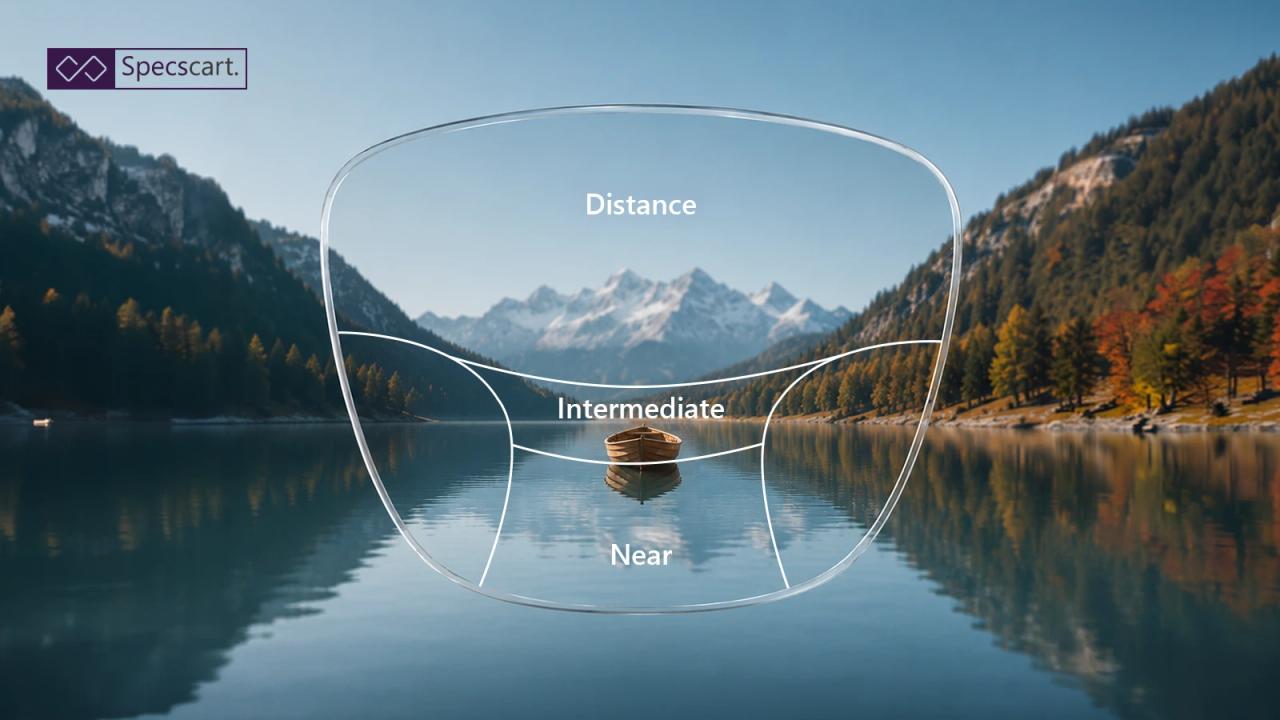




Most people know that varifocal lenses help you see clearly across near, intermediate, and distance vision in a single lens. However, many people are still not aware of how these lenses work. With advancements in varifocal technology like digital surfacing, this question has become even more relevant for modern varifocals. All the magic of varifocal comes down to how the surface of the lens is shaped. Once you understand that, the whole thing starts to make a lot more sense.
Different Prescription Powers Across the Surface

A varifocal lens has a different optical power at the top compared to the bottom. You get a distance vision prescription at the top, while the bottom corrects near vision. In between, the power gradually shifts, and it covers intermediate vision. The surface of varifocal lenses physically changes shape from top to bottom to achieve this. It’s neither flat nor uniformly curved across the surface. Instead, the curve changes continuously across the lens surface to produce that gradual power shift. The kind of surface is known as a freeform surface, and it’s what makes varifocal lenses possible without any visible line.
The Corridor Your Eyes Move Through

The power shift in varifocal lenses doesn’t happen across the full width of the lens. It follows a central path that runs down from the distance zone at the top to the reading zone at the bottom. This path is known as the progressive corridor, and it’s the clearest route your eyes travel when shifting between distances. Even the intermediate zone in between that is used for tasks like reading a screen, checking a price tag, or seeing a dashboard, also falls in the progressive corridor.
The width of this corridor depends on the lens design. In basic varifocals, which are often sold for lower prices, this corridor is quite narrow, which makes adjustment take more time. Additionally, it also makes it trickier to always fall within the corridor. In advanced designs like Innovator 4D or Innovator UHD at Specscart, that corridor becomes wider, which makes it easier to adjust and provides a reliable viewing experience.
Why There's Blur at the Sides

Most of you may already know that lenses bend light to help you see clearly. But to help you see both near and far, they have to bend light differently. That’s why the surface of the lens changes in thickness and curvature, which allows it to bend light differently for distance and near vision. In bifocal lenses, it’s easy to achieve. They are simply joining two different curves at a visible line which separates one step up and the other down. It's abrupt, but because each zone is its own distinct shape, neither one interferes with the other. You can learn more about the difference between bifocals and varifocal lenses for more information.
The process becomes far more complex in the case of a varifocal lens. Instead of a step, it needs a smooth, continuous slope from the distance curve at the top to the reading curve at the bottom. All of this happens with no line, no jump, and no break. The problem is that when you pull a solid surface into two different curves at once, the material between them has to go somewhere. You can take the example of stretching a sheet of rubber. You can pull the bottom toward you for reading, keep the top pinned flat for distance, and the sides have no choice but to buckle and warp. This warped area is where you find blurriness. Our lab team call the same thing peripheral distortion, but I think we can ignore their technical fluff for easier understanding.
How Modern Varifocals Deal With Peripheral Distortion Better

The biggest limitation with traditional varifocals was that lens designers had to refine the surface shape based on general averages and hope it worked for everyone. I don’t even need to explain to you the limitations of this practice, as it couldn’t work for everyone. The progressive corridor used to be narrow, the edges were distracting, and it used to take a lot of patience to get used to these lenses.
Modern varifocals changed that with freeform technology. Instead of grinding the lens surface using a fixed template, freeform uses computer-controlled surfacing. It is precise enough to calculate and shape the lens point by point across its entire surface. This control allows us to map and reposition the warped zones with far greater accuracy, and we are able to push the buckled areas further toward the outer edges. It keeps the progressive corridor wider and more usable.
Digital RayPath technology used in Specscart varifocals takes this one step further by factoring in how light actually travels from the lens to your specific eye. There are multiple factors that affect how light reaches your eyes in real life, like your pupillary distance, the angle of your frame, how far the lens sits from your eye, and the tilt of the frame on your face. Digital RayPath uses your individual measurements to recalculate the entire lens surface around how your eyes actually work. As a result, you get a corridor that’s positioned where your eyes naturally move. The transition feels even smoother as they're designed around your gaze rather than a fixed template. This makes the adjustment smoother, and you get a better viewing experience without worrying about the peripheral distortion in the long run.
What It All Means in Your Day-to-Day Life
Hopefully, you didn’t come here to make varifocal lenses at home by understanding how they work. Understanding all this doesn’t make sense if you don’t get any real benefits from all this in your day-to-day life. Until AI becomes advanced enough to create varifocal lenses based on your prompt, our personalised varifocals give you many improvements over standard varifocals that you notice in your daily life.
You glance down at your phone, then up at the road. You look across the table at someone, then back at the menu. You check your laptop, then look at the clock on the wall. All of that happens without you thinking about it because that's exactly what a personalised varifocal is designed for. If you have any further questions, you can feel free to contact our friendly customer support team, and they’d be happy to help.
Caution: You may become style obsessed